Malaysians love to complain our subsidies are biased. We checked the data

- 2.9KShares
- Facebook2.9K
- LinkedIn2
- WhatsApp3
The other day, this writer mentioned wanting to apply for a government grant. Out of nowhere, the writer’s uncle goes, “Aiya, you won’t get one la. All these bantuans are for Bumiputera only.” Like okay uncle, love the support as always 🫠.
Jokes aside though, it got this writer thinking.
There’s this long-standing perception – especially among the older generation – that government aid only goes to certain groups, mainly Bumiputera. And to be fair, that was pretty true back in the day. But times have changed and we couldn’t help but wonder how much of that still applies today.

Under the MADANI government, there’s been a push to restructure subsidies and aid and we gotta say we’re curious to see how the numbers stack up. So, we dug into two chunky datasets – one on individuals and households, another on businesses – to see who’s actually getting what. After tirelessly sorting all that info into spreadsheets, we can now get to the billion ringgit point, specifically…
3 in 4 business schemes are open to all Malaysians, tak kira race
From the business dataset, we counted 86 entrepreneurship/SME financing schemes which had all their application details available. Out of these, about 23% (20 schemes) are strictly Bumiputera-only. Examples include MARA loans, TEKUN financing, and some community-based programmes like DanaNITA (women entrepreneurs), SJUM (loan guarantees), Payung ecosystem financing, Jaguh Serantau, and Pembangunan Ekonomi Bumiputera.
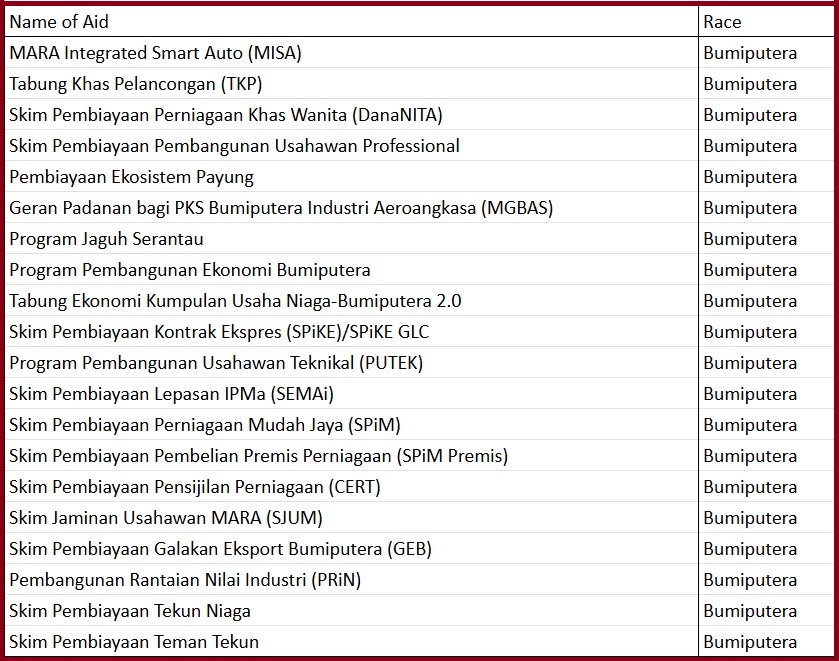
One thing we noticed is that while they’re not that many in number, a lot of these Bumiputera schemes are either among the longest-running ones, i.e. MARA-linked, or they’re tied to big national economic transformation plans like Pembangunan Ekonomi Bumiputera.
On the other hand, the majority (60+ schemes) are open to all Malaysians, provided you tick the necessary boxes like being an SME, a startup, under 30, women-owned, or in a green economy sector.
There are also a couple that specifically target Indians (SPUMI) or Chinese (Skim Pembiayaan Perusahaan Kecil Komuniti Cina), but these are just 2 out of 86 schemes.

So to put that all into less words and more numbers, here’s what the actual breakdown looks like:
- 23% Bumiputera-only
- ~2% Chinese- or Indian-specific
- ~75% open to all (with conditions like sector, age, or gender)
Turns out, while Bumiputera-only aid makes up a significant chunk, it’s nowhere near as overwhelming as we expected. So imagine our surprise when we jumped over to the individuals/households list… and realised none of them have anything to do with race at all.
For individuals and households, aid is mostly based on how much you pocket
When it comes to personal or family-related subsidies and bantuans, the first thing to know is race doesn’t actually pop up in the requirements. Out of the 48 schemes we looked at, not a single one said you must be Malay, Chinese or Indian to apply.
So what does matter? A few things actually;
- Income level : If you’re part of the B40 or to an extent, M40, you qualify for a whole range of aid like STR (Sumbangan Tunai Rahmah), SARA (cash aid top-ups), or BUDI Individu (RM200 monthly fuel subsidy).
- Occupation : Farmers and fishermen get their own tailored support, like padi/rubber replanting schemes or the Elaun Sara Hidup Nelayan. Civil servants also get their yearly Khas Kewangan bonus.
- Vulnerable groups: If you’re an OKU, a housewife (through i-Suri and Lindung Kasih), or even a widow/divorcee (via i-Sayang), there’s something earmarked for you.
- Students : Whether you’re still in school or heading to uni, you might get a Baucar Buku MADANI, Bantuan Awal Persekolahan, or even the FLYsiswa travel aid.
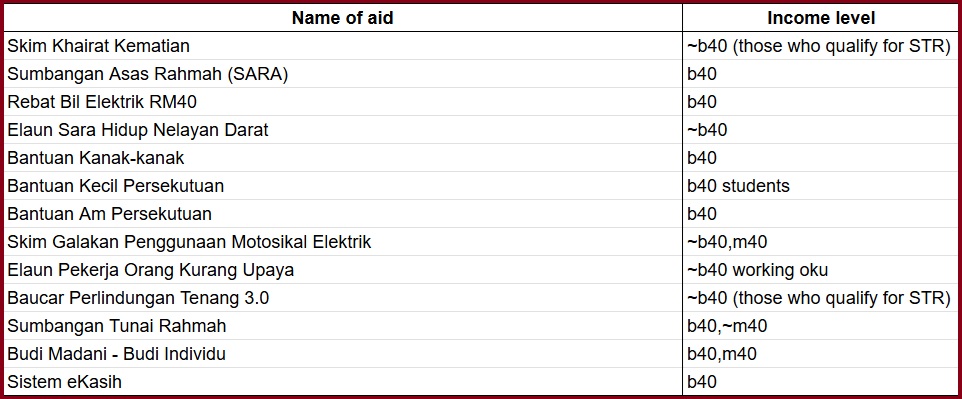
Without a doubt income level is the biggest deciding factor here, what with 13 out of the 48 schemes targeted this way.
Now, here’s the tricky part. Even though these schemes are technically race-free, the outcomes don’t always look race-neutral due to Malaysia’s income demographics.
The aid distribution may seem uneven, but it’s really about targeting those who need it most

Because around 70% of Malaysia’s B40 households are Bumiputera, any initiative targeting low-income groups will naturally result in more Bumiputera recipients. The outcome isn’t due to race-based eligibility, but rather income demographics.
Interestingly, however, this skew can be traced back to long-standing socioeconomic structures that began during the colonial era. Due to the British’s divide and rule policy, by Merdeka, Bumiputeras held less than 3% of corporate equity despite making up the majority of the nation. To reduce that massive wealth inequality, Programs like MARA, TEKUN, and DanaNITA were created in the 70s, and today, they still exist as legacies of that effort.
In more recent years, however, the aid system has gradually evolved. Instead of blanket or race-based approaches, newer schemes are increasingly tied to factors like income level, economic sector, and target groups such as women, youth, and startups.
What’s particularly notable in Belanjawan 2025 is how this shift continues, with more schemes now tied to strategic goals like digitalisation, green industries, upskilling, and entrepreneurship. The focus is not just on providing aid, but on helping Malaysians move up – whether through higher incomes, better jobs, or new business opportunities.
Take Skim Jaminan Kredit Perumahan (SJKP), for example. It helped over 14,000 Malaysians without payslips purchase homes through government-backed guarantees. At the grassroots income level, Inisiatif Pendapatan Rakyat (IPR) supports small food operators, farmers and service workers raise steady income, while microfinancing programmes under TEKUN, BSN, and MARA continue to give small enterprises the capital they need to grow and scale.
Aside from that, community-level programmes like Naik Taraf Klinik Daif, Naik Taraf Sekolah Daif, and Kampung Angkat MADANI have upgraded 460 rural clinics, 30 schools, and supported 200 kampung projects, helping to close the development gap between rural and urban areas.
And on that note, what really struck us as we dug into all this data was the sheer number of bantuan and programmes out there. Genuinely, it’s a whole buffet! 🍽️

So if you’re curious or if you just wanna see if you qualify for something, check out our two Excel sheets for individual/household aid and business aid. Or better yet, you can head over directly to the Manfaat Belanjawan website here.
- 2.9KShares
- Facebook2.9K
- LinkedIn2
- WhatsApp3