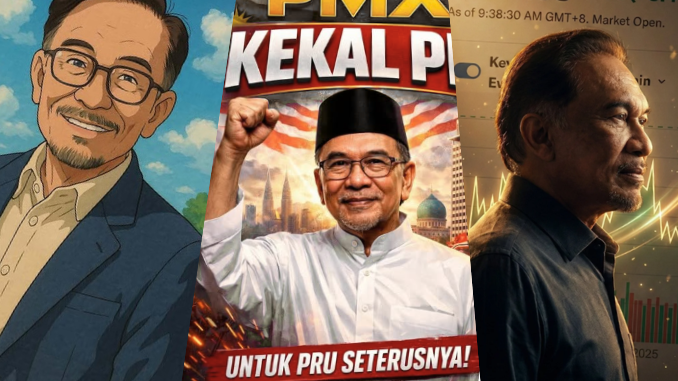
Eh, how come there’s so many AI pictures of Anwar Ibrahim on FB?
It’s actually kinda diabolical how much AI-generated content is floating around social media these days, so much so trying to avoid it feels like an Olympic sport. People are using it for literally everything– from generating profile pictures, finishing last minute assignments to churning out those bizarre videos that somehow end up in your family’s WhatsApp group.
@budakchatgpt Abang Oyen buat hal lagi daaa… #oyen #ai #dramakucing #lawaktiktok #AIArt
And you can’t even escape it by putting down your phone cos the AI aesthetic has officially infiltrated corporate boardrooms and government ministries.
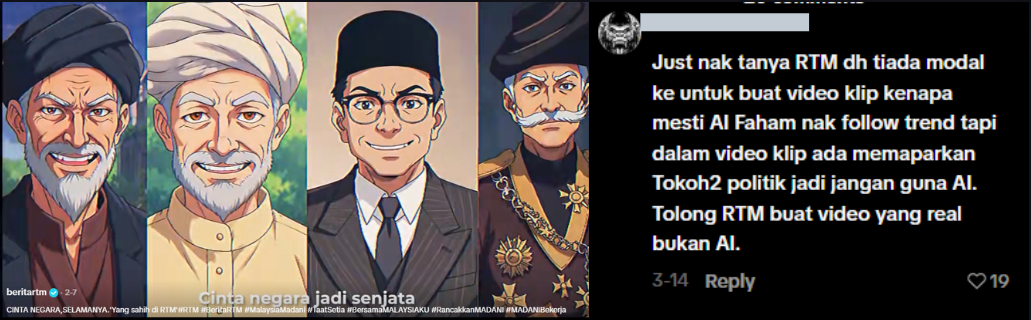
More and more campaigns are using AI-generated posters, infographics and visuals. It’s usually pretty easy to tell when they use them though, like when you suddenly spot eight fingers on a hand or text so soulless it feels like it’s draining the life out of you. Even on TV, you’ve probably noticed RTM going absolutely wild with the effects lately.
Btw if you’re more of a visual person and just saw the length of this article and panicked a bit, don’t worry. We actually made a video version too, so you can go watch that instead.
Back to the matter at hand, if obviously weird AI content is already slipping through and getting published, what happens when it’s used for more serious stuff? We’re talking about things involving the country, politicians, the economy, even elections. Cos you see, today’s AI can generate convincing photos, voices and videos at ridiculous speed. And in the wrong hands, that’s straight up narrative control, y’know, where people can deliberately shape what you think and how you see things.
In several neighbouring countries, AI is already being used in political campaigns, online propaganda and social media narrative wars. Malaysia looks like it’s slowly heading in the same direction too. And if you think this is something we can still stop, 🚨news flash🚨, we’re probably already past that point. The real question now is how deeply it’s already embedded in the political scene without most of us even realising it.
Across the border, AI is used like a propaganda tool to shape how people see politicians
Take Indonesia, for example. By the time the 2024 presidential election came around, AI was already a visible part of the campaign landscape. To get a clearer picture of what that looked like on the ground, we spoke to Alfons from Tirto.id and Arsito from Suara, who’ve been tracking how AI was used throughout the election period there.
They very quickly pointed out Prabowo Subianto’s campaign, which leaned heavily into cute, cartoon-y AI images to create this so-called ‘gemoy’ version of him. If that description flew over your head, in simple terms, this was a branding makeover using AI that transformed Prabowo from a tough political figure into someone who appeared softer, friendlier and way more approachable.
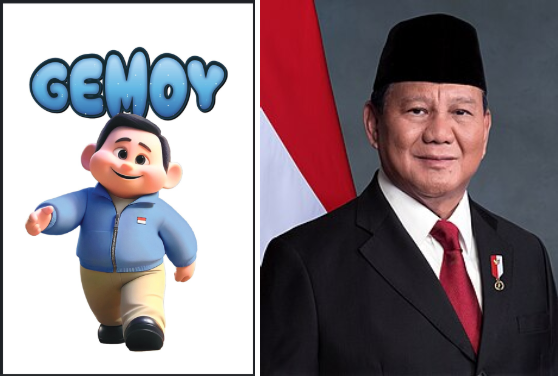
But why even the need to do this?
Well, Prabowo didn’t exactly start out with a warm and fuzzy public image. His reputation was shaped for years by his stern military background and a fair share of political controversies. So this gemoy persona basically worked as a reset. It shifted public attention away from that heavy image and towards a more relaxed, friendly, almost cute uncle-next-door version of him.
And it looks like the strategy worked. In the 2024 presidential election, Prabowo won outright in a single round. Of course, that win came from a mix of many factors but his digital strategy, i.e. the memes, AI-generated visuals and the whole gemoy branding, definitely helped him stay visible and relatable, especially among younger voters who live online.
Now towards the east in the Philippines, we also worked with John Hurt from PressOne.ph to get a similar AI-in-politics overview. One big moment he highlighted was the arrest of former president Rodrigo Duterte following an International Criminal Court (ICC) investigation into his drug war. FYI, this was a campaign long linked to thousands of deaths and human rights allegations.
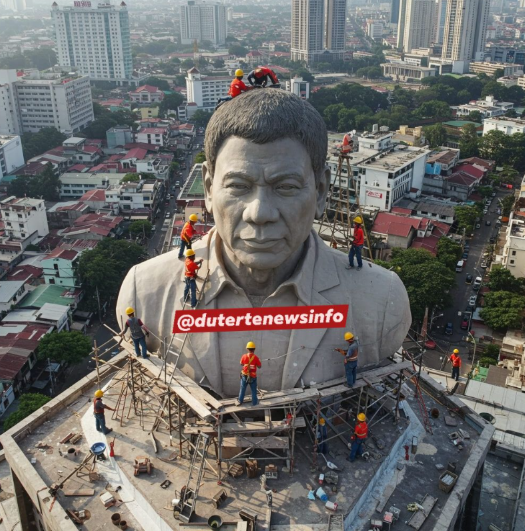
Now, whether AI actually works as a political tool is still an open question. The legal cases are ongoing and the digital narrative battles are still very much alive. But the one thing that’s clear based on John’s observations is that AI is actually being deployed very deliberately. In practice, it’s used to protect political images, shape emotions among supporters and influence how the public sees these political leaders.
Sheesh. Some that’s some real Evil Knievel stuff going on there.
If you zoom out a bit and look at Indonesia and the Philippines together, what stands out is how similar the playbooks can be across very different political contexts. By similar, we mean AI being used with clear narratives, consistent messaging, and content that often feels like it’s coming from a coordinated digital campaign.
Now add in how ridiculously easy AI tools are to use today, and it puts an even more unsettling spin on things. You can literally type a prompt into tools like ChatGPT and generate images, videos or scripts in seconds. That is to say, all these stuff are produced at lightning speed and just as quickly, pushed straight into public feeds.
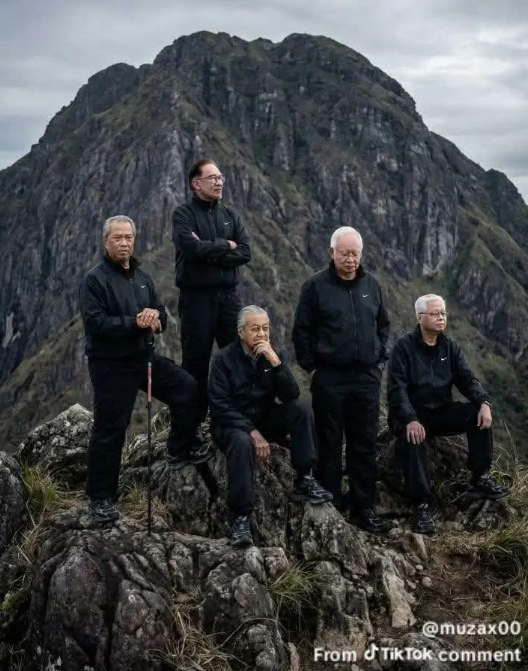
Which is exactly why we decided to do a bit of digging ourselves, to see how far AI has actually gone in Malaysian politics. And what we found… wasn’t quite what we expected.
AI content is already being used in Malaysian politics, just not in an organised way yet
From January to April 9th, we manually tracked AI-generated content across several social media platforms linked to local politics. We were looking at images, videos, songs and visuals connected to Anwar Ibrahim, the current government, economic issues, government policies and broader political narratives.

When we went over the data, the first thing that really jumped out was how different Malaysia is compared to Indonesia or the Philippines. As we mentioned earlier, AI use over there feels super structured, almost like a coordinated campaign tool with clear messaging and consistent visuals. But here in Malaysia, the use of AI is a bit all over the place, in the sense it comes from multiple different sources and is shaped by whatever issues are current.
To build this dataset, we tracked AI-generated content across five major platforms. Facebook had by far the largest share of posts ahead of all platforms at 61.8%. Threads was the second at 13.2%, followed by X at 10.3% and TikTok at 8.8%. Instagram had the smallest share at just 5.9%.
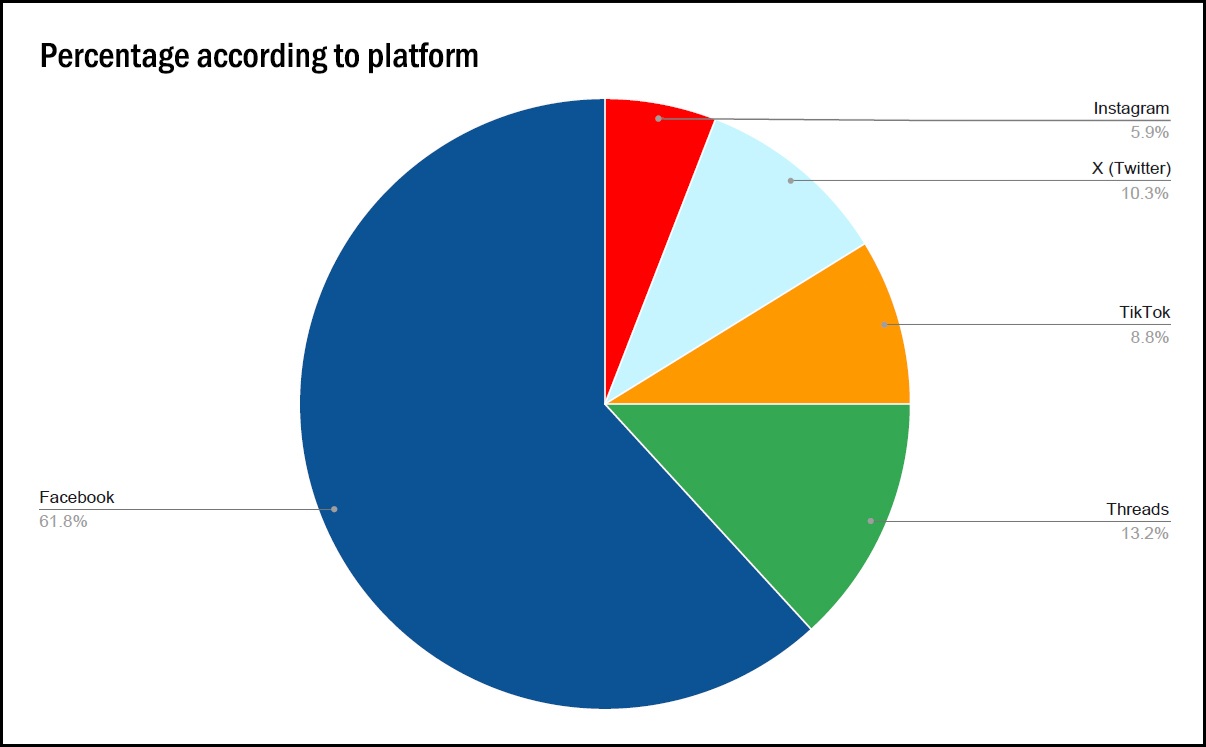
So long story short, if you wanna see where the AI political action is happening in Malaysia, Facebook is where it shows up most clearly. Political groups and supporter pages are still the main spaces where these visuals are shared, whether it’s to support their own side, criticise opponents or simply to jump on the issue of the day.
But surprise surprise, the content isn’t completely random. Across the dataset, we noticed that the same few themes kept popping up, just slightly tweaked and circulated by different accounts.
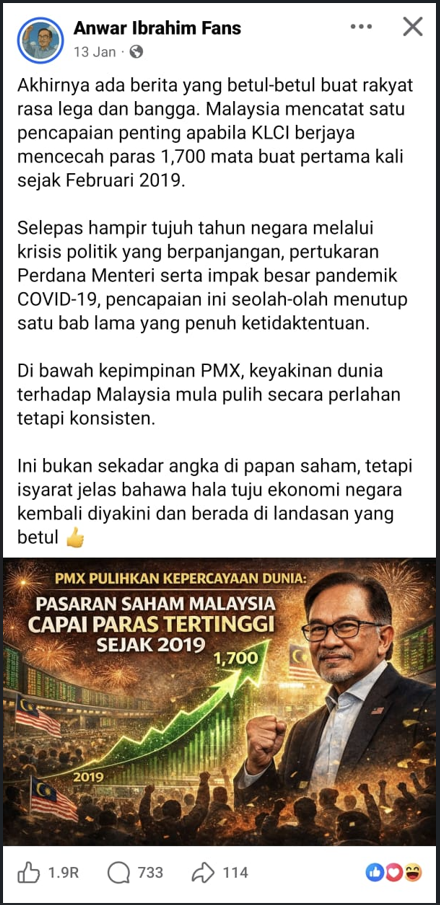
Among the most common narratives were images of PM Anwar paired with economic graphs, claims that the PMX (Anwar) has restored global confidence in Malaysia and visuals suggesting that the country’s international rankings are improving.
On the flip side, the anti-government fellas seems to be leaning more into cost of living issues, specifically fuel prices. We actually found at least three different sets of AI-generated visuals that were all pushing pretty much the same message.
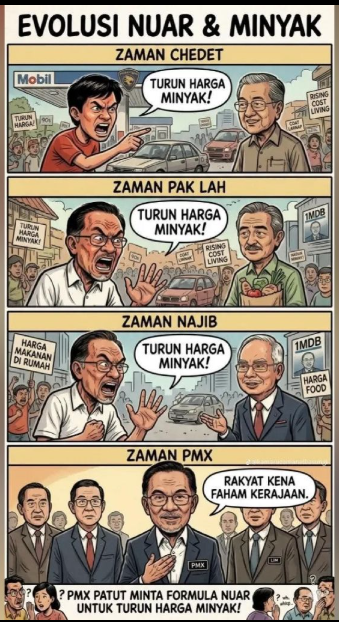
One clear example was a series of AI-generated comic strips called “Evolution of Fuel“. We tracked down eight separate posts from eight separate accounts all sharing the exact same thing, like the one you see below.
Then there were these satirical comic-style posts like the one below, which question why fuel prices keep going up and never come down. In total, we found 10 such posts from 10 different accounts.
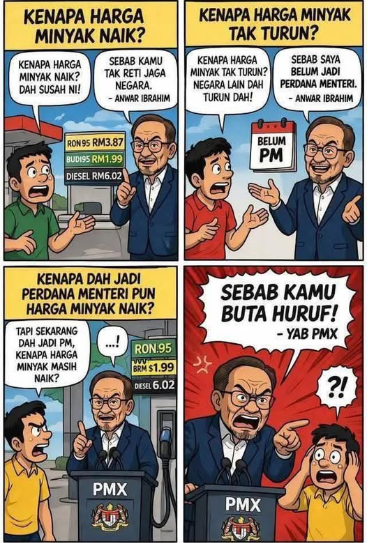
Even though the formats were different, they were all pushing the same criticism of the government, mainly around the burden on the people and claims that Anwar has failed to deliver on earlier promises.
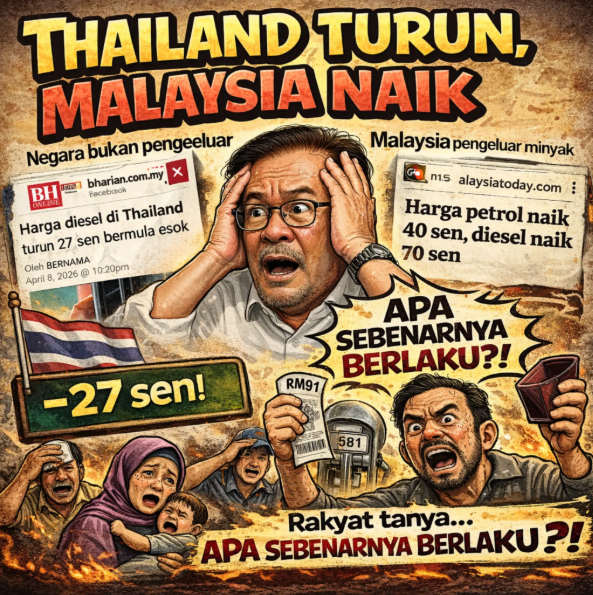
Another recurring visual theme was comparison graphics showing fuel prices in Thailand going down while Malaysia’s went up. We recorded 11 posts from 11 different accounts using this exact narrative. And while the visuals varied from the comic-style posts mentioned earlier, the core message was still centered on the same issue.
When you break it down by narrative, both pro and anti-government content actually revolve quite heavily around Anwar’s performance as PM. The difference is really just whether it comes in the form of praise or criticism.
Pro-government posts often frame Anwar as a leader worth keeping in office. They highlight things like economic recovery, investor confidence, lower unemployment and a rising stock market. Anti-government posts, on the other hand, focus more on everyday pressure points. This includes things like fuel prices, cost of living and promises that haven’t really been fulfilled.
So essentially, it comes down to one side trying to build confidence, while the other is trying to chip away at it.
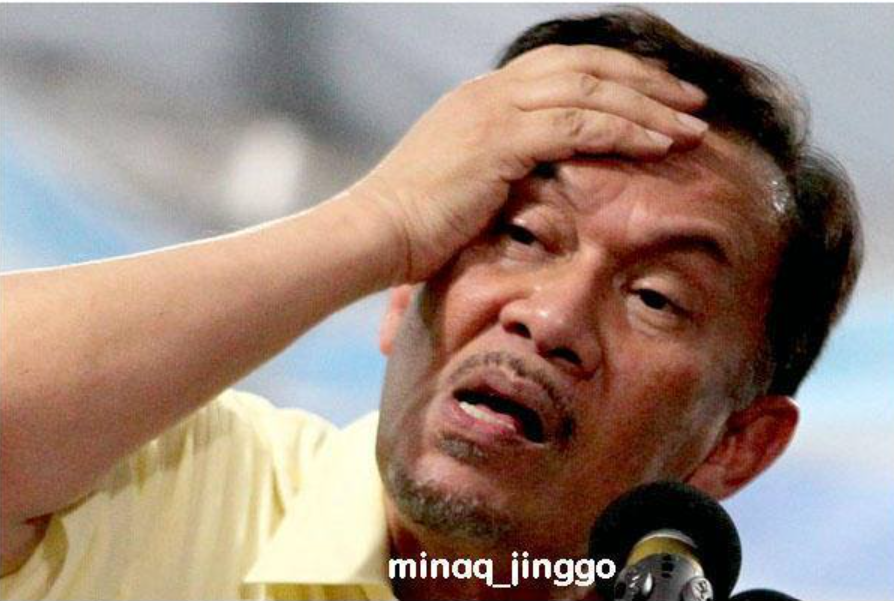
At first glance, these AI-generated comics might just look like harmless jokes or satire. But when you see them over and over, they can really start to shift how people feel. And when we really go down that path, that’s the kind of thing that could actually sway how people vote when the next election rolls around.
Which makes you wonder, between the two camps…
Which narrative does better on social media?
If you look at engagement numbers alone, pro-Anwar content seems to have a pretty active base. These posts get likes, comments, and support from existing supporter pages and communities. So it’s clear there’s still a group that actively engages with this kind of messaging.
But the story changes when you look at how far it spreads. Anti-Anwar content tends to travel more. Posts about fuel prices, cost of living and past promises get reshared more often across platforms. So while pro-government content has stronger engagement within its own circle, anti-government content seems to reach further beyond its usual audience.
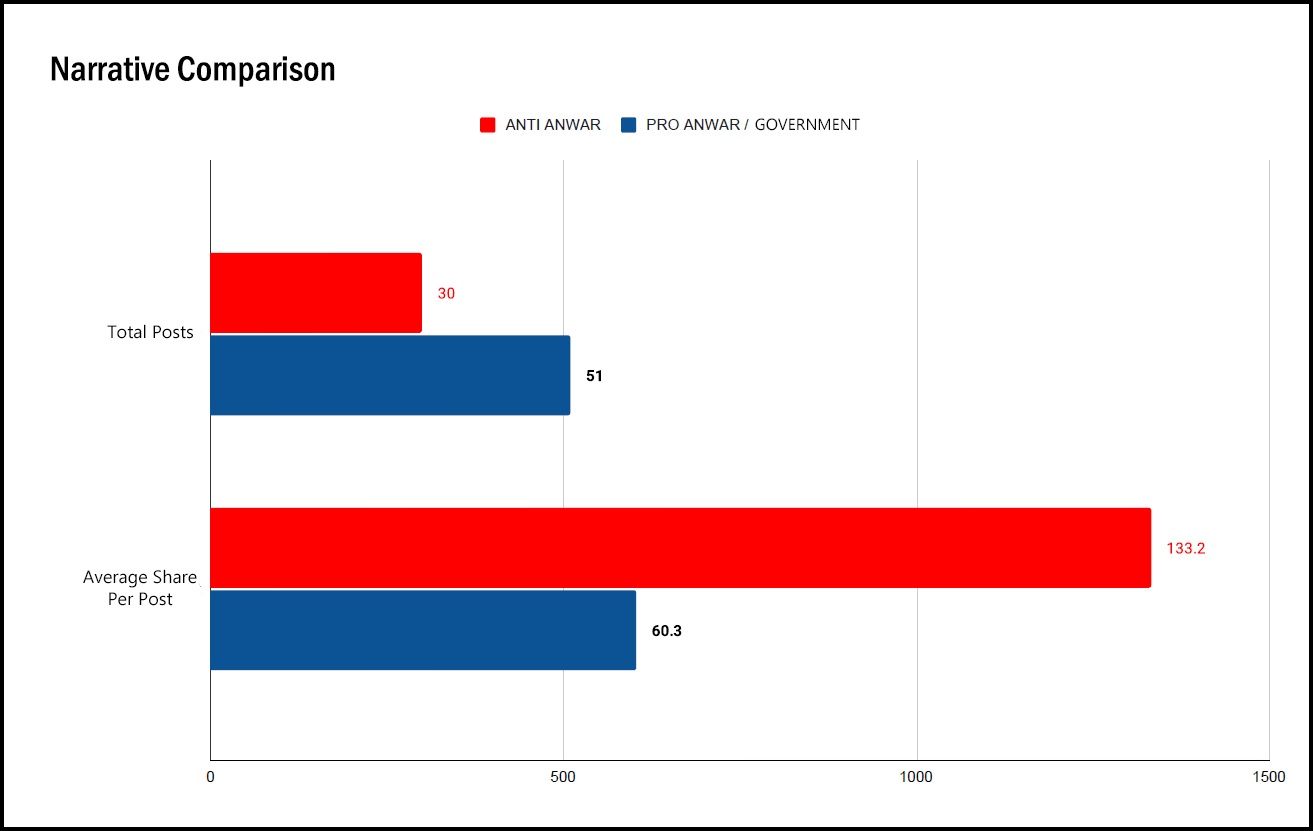
On average, anti-Anwar narratives had about 133 shares per post, which is higher than pro-Anwar content at around 60 shares.
But you have to take those high engagement numbers with a grain of salt. A mountain of likes and comments doesn’t always mean the support is 100% organic. In a lot of the posts we checked, the comments were just a wall of emojis or one-word replies. This usually means the engagement is coming from close supporter circles where people are basically echoing each other.
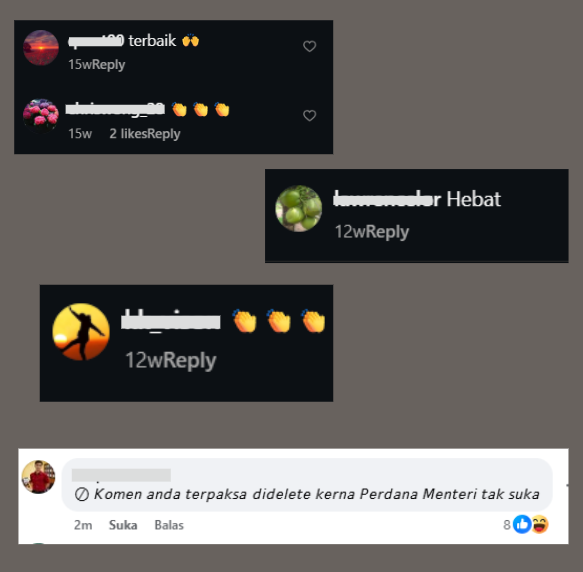
On the flip side, even though anti-Anwar content had lower engagement overall, it actually got shared way more. That suggests sharing is driven less by agreement and more by emotion, especially if it’s anger or frustration.
If you find that hard to grasp, think of it this way- people might scroll past a post praising the government without much reaction but they’re far more likely to share something that makes them feel annoyed, criticised or burdened. And that’s the key difference.
At the end of the day, it’s a reminder that in the world of social media politics, raw emotion is still what really pushes content to spread. So…
Who is actually driving AI-generated political content in Malaysia?
If we look at the numbers, individual accounts are doing most of the posting, with 43 posts compared to 20 from Facebook pages. In other words, AI-generated political content is coming more from everyday users than from big organisations or official pages.
And that kind of makes sense when you think about it. AI tools have made it really easy for almost anyone to whip up political posters, memes or visuals without much cost or effort. So instead of being limited to official pages, you now see individual accounts jumping in faster and reacting almost immediately to whatever’s happening.
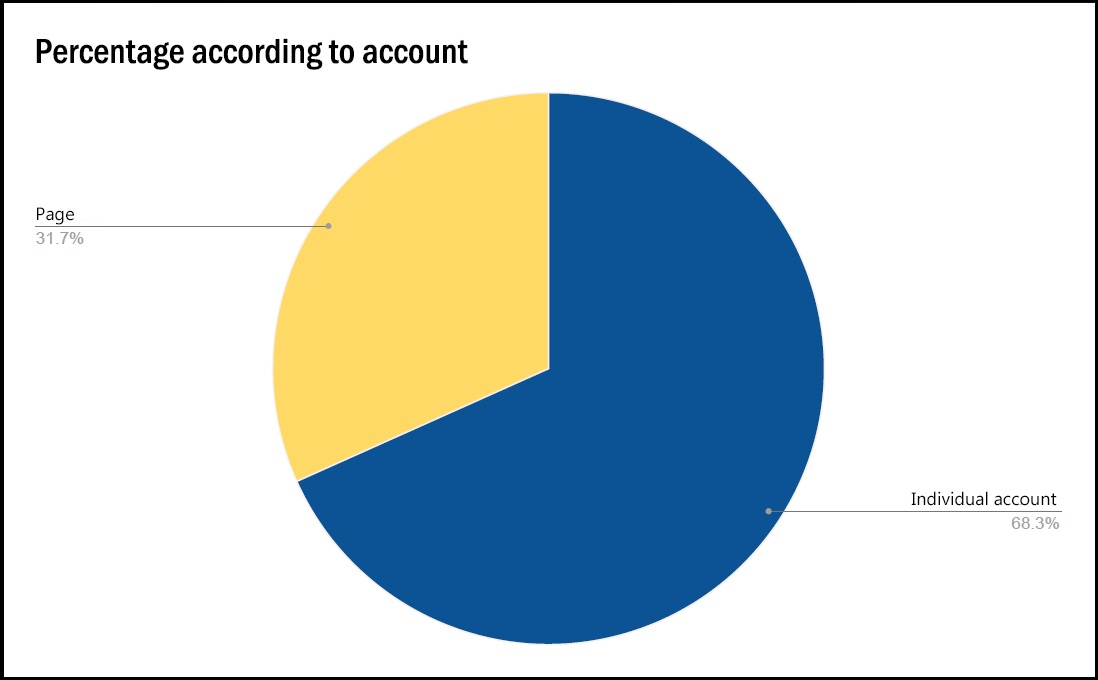
But having more posts doesn’t automatically mean having more influence. You’ll see exactly what we mean in the next graph so let’s break it down step by step.
Looking at average engagement per post, Facebook pages are well ahead, with around 2,362 engagements per post compared to 1,039 for individual accounts. So even though pages post less, their content tends to pull more attention and generate stronger reactions when it does appear.
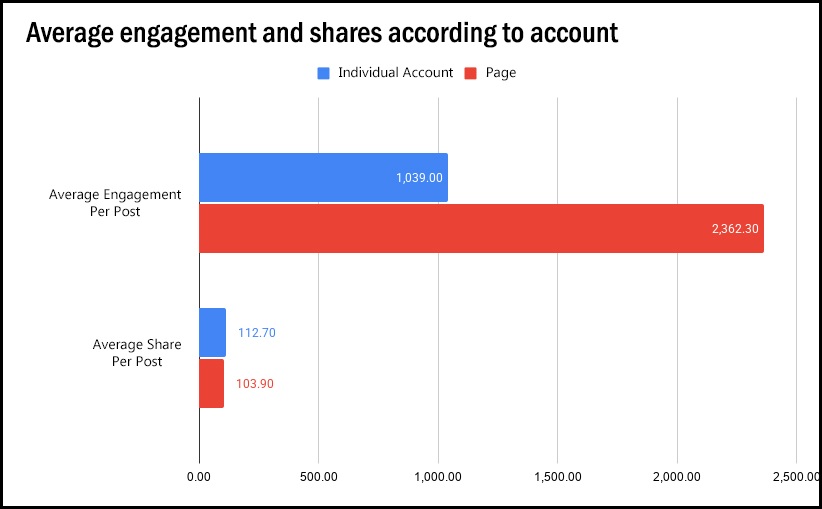
When it comes to shares, it flips slightly. Individual accounts average about 112 shares per post, while Facebook pages sit at around 103. So content from personal accounts might not always get as much engagement, but it does get passed around a bit more easily.
What this really tells us is that established political pages still have a clear advantage. With a name people already recognise, loyal followers and an existing audience, they don’t need to post often to stay visible. Even a single post can still make an impact.
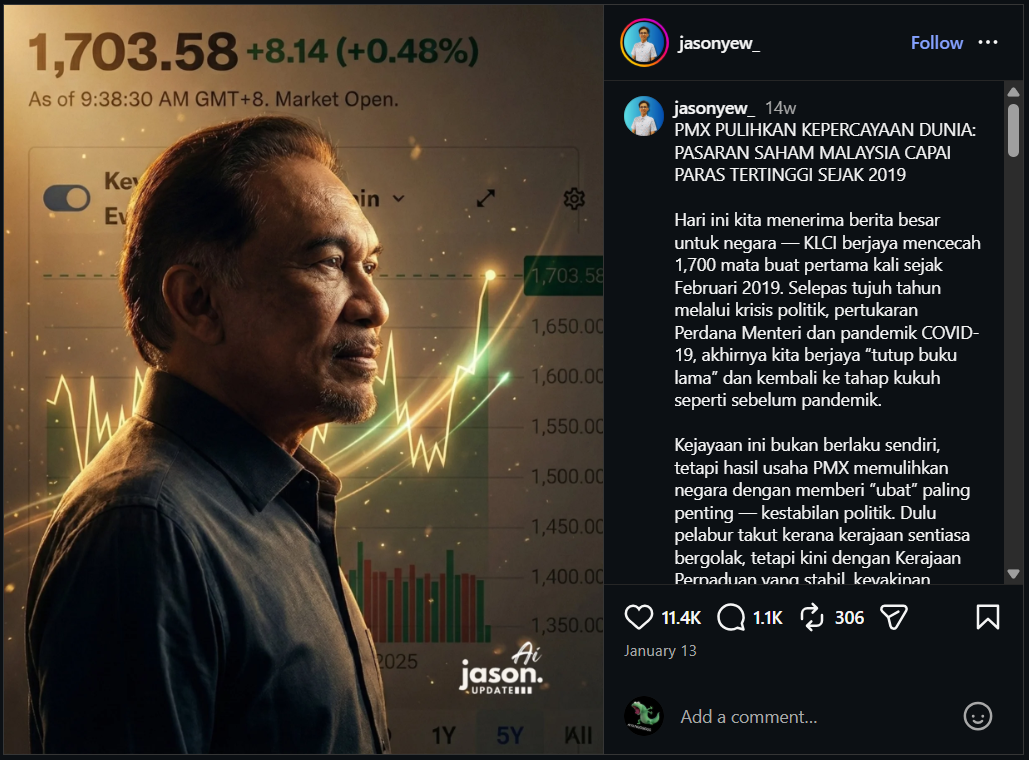
Meanwhile, individual accounts still matter when it comes to both volume and reach. With more posts and slightly higher average shares, this group remains a key driver in spreading AI-generated political narratives in Malaysia. So the question now…
Is this actually a good thing or not?
To get a better sense of this, we spoke to Amir Fareed, the Strategy Director at KRA Group, a political research and strategy firm. He explains that AI-generated content is a bit of a double-edged sword. On one hand, it makes political content much cheaper, faster and easier to produce.
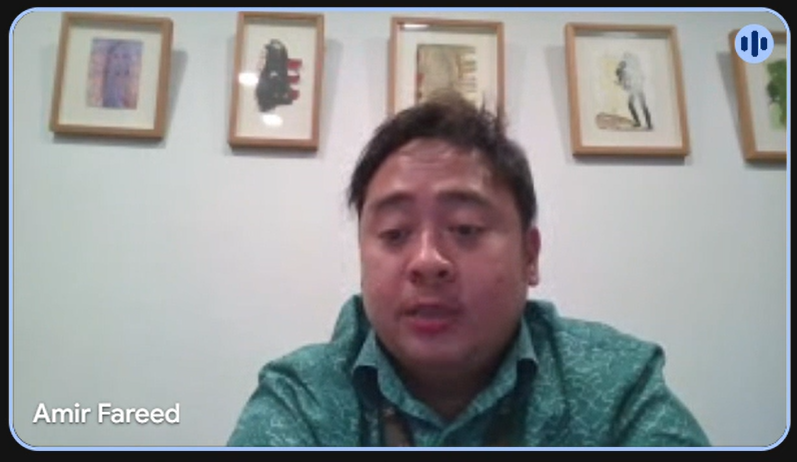
Back in the bygone days (pre-AI), something like a political poster, response video or graphic would need designers, editors and a whole boatload of time. Now though, a lot of it can be done in a short span. And in politics where things move quickly based on daily issues, being able to respond fast is super valuable and a big advantage.
“By nature, AI will be used because this technology is a double-edged sword. On one hand, AI reduces the cost of political communication and speeds up content production. In politics, timing is everything. Whoever delivers the message fastest often has the advantage.”
– Amir Fareed, translated to English by Cilisos
He also confirmed our worst suspicions that AI is already making its way into Malaysia’s political space, especially as a campaign tool. One example he shared was AI-generated videos during the Sabah election in November 2025, which were used to mock and criticise the then-government.
@inisuarasabah Sabah ini bukan mana-mana kaum yang punya .. Sabah kita, Milik semua orang Sabah .. #Originalsabah #warisanpenipu #GRS #PKR #PRNSABAH
So this isn’t just something happening in neighbouring countries anymore. It’s already starting to show up locally as a tool for attack, promotion and shaping political perception. And according to Amir, we’re likely to see even more of it as elections creep closer and inadvertently, get more intense.
At the same time, this convenience comes with serious risks. When it becomes too easy to generate content, it also becomes too easy to spread misinformation, manipulation and large-scale propaganda.
And worse, if everyone starts relying too heavily on AI to attack opponents or push narratives, people might just get tired of it all and tune out from politics completely. So while AI can help politicians push their messages faster, it doesn’t necessarily mean people will keep paying attention.
So… as elections get closer, what happens next?
Looking at the overall data, it’s clear that AI is starting to play a more noticeable role in Malaysian politics. Pro- and anti-government content is already out there on multiple platforms, the different narratives themselves are becoming more defined and AI itself is being used to praise leaders, attack opponents, and frame current issues.
While we haven’t hit the same level of AI saturation as some of our neighbors just yet, these early trends show that AI use is officially becoming more mainstream. In fact, it’s already shaping how our local politics plays out on social media.
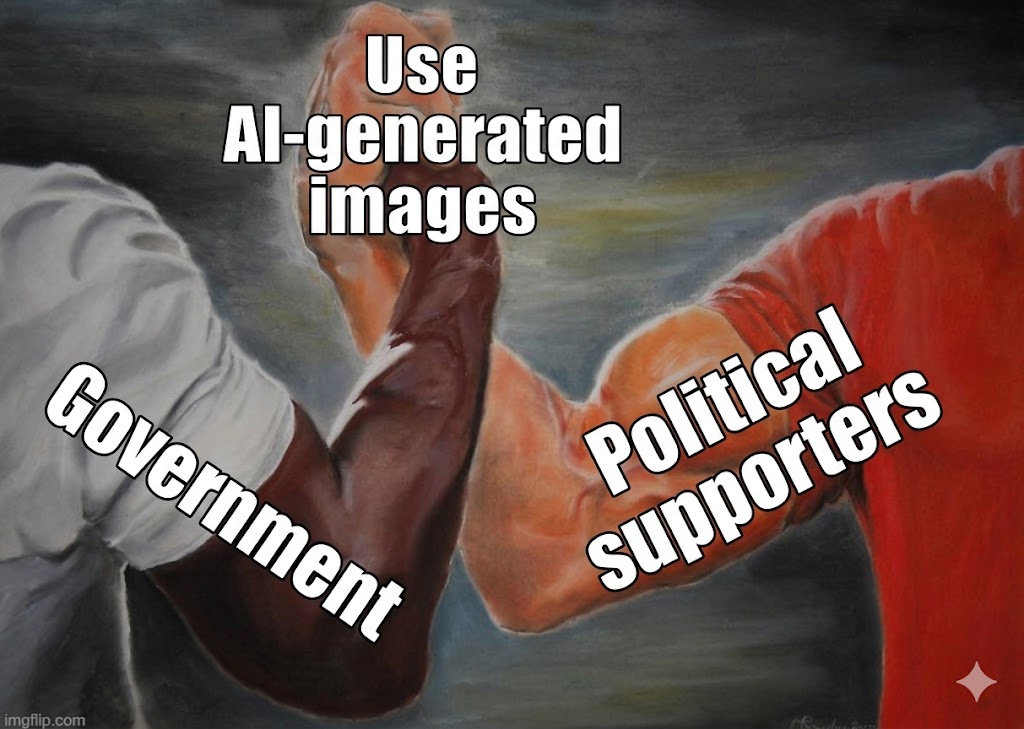
At the same time, the tech is getting so good that it’s becoming really hard to tell what’s real and what’s AI-generated. This opens up a whole can of worms for misinformation, manipulated images of politicians and content that can easily mislead people without them realising it.
@trpmsia A Threads user claimed an elderly couple from Kuala Lumpur was duped by the AI-generated video showing an alleged new cable car system. 🎥: @ybda02 via TikTok
And honestly, this is just the tip of the iceberg. With talk of GE16 already out there, you can bet AI content is gonna be a permanent fixture in our feeds. Some political parties are already discussing seat targets and starting early preparations for the next general election.
So moving forward, brace yourself. We’re probably gonna see a lot more posters, videos, memes and mayhaps more sophisticated forms of propaganda that’ll make everything we’ve discussed now look like child play.