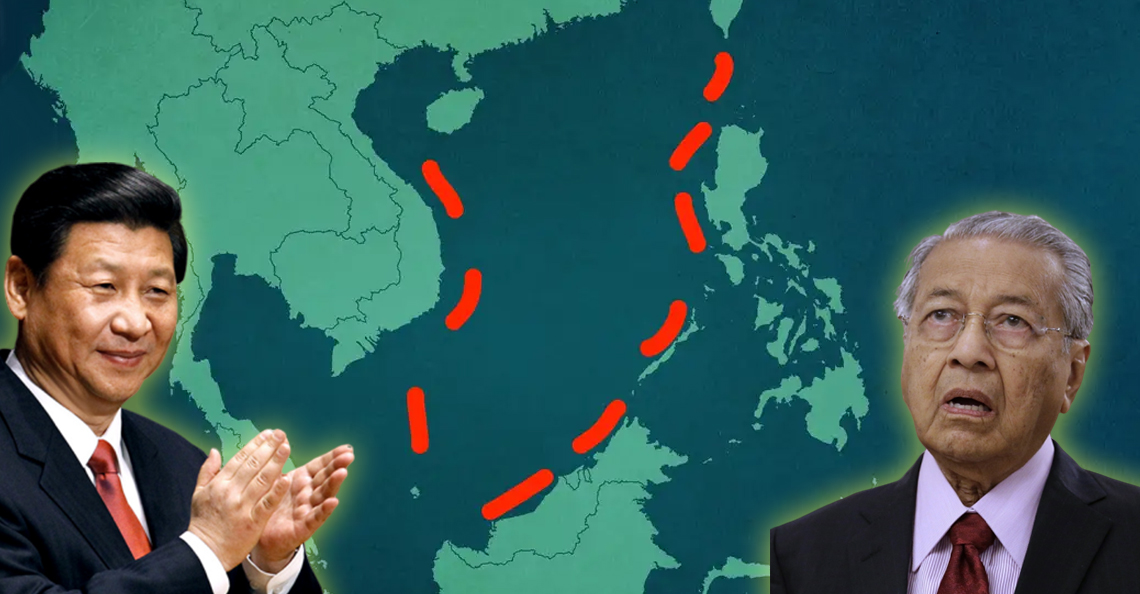
Are Malaysian news outlets pro-China? We analysed 300+ articles to find the truth
So… how much do you guys know about the South China Sea?
Welp, before any smarty pants here jumps in with a “it’s in the South of China” (😞🙏🏼), we’re actually talking about the messy, complicated, territorial tug-of-war involving China and several ASEAN countries, including Malaysia, where basically everyone wants a piece of that big yummy sea (China perhaps a bit more enthusiastically than the others).

TL;DR, China has been asserting claims over most of the South China Sea since 1947. Despite overlapping claims from multiple countries, they continue to treat a huge chunk of the sea as their own. And we don’t say that loosely either what with these guys just straight up cruising down the waters of other countries.
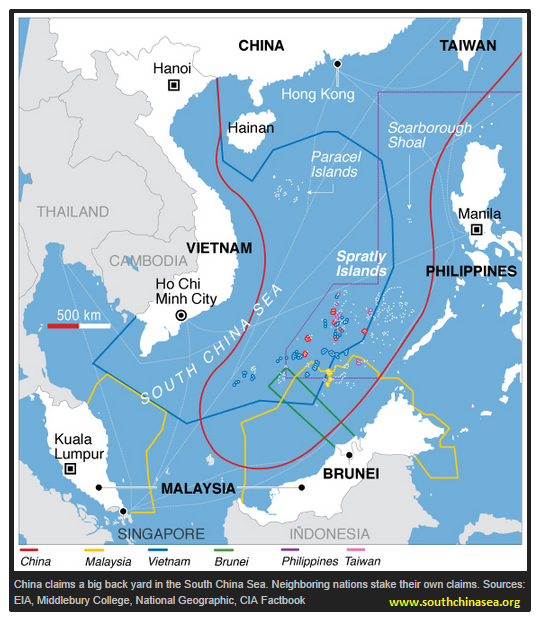
Now imagine this in a more everyday way. Say you have a neighbour who keeps sniffing around your house compound uninvited, never mind they’re this huge taiko and they claim their great great grandfather once owned the land donkey years ago. But it’s your house now and your compound, surely even you would think it’s rude and some sort of illegal, no?
So naturally, you’d expect Malaysia to be pretty vocal when it comes to defending our own maritime territory. But no, shock horror! While countries like the Philippines and Vietnam have no problem calling out China for their transgressions, Malaysia tends to be way more chill about it. So chill in fact, you’d think we don’t care. But what kind of nincompoop refuses to defend their own home? Sus.
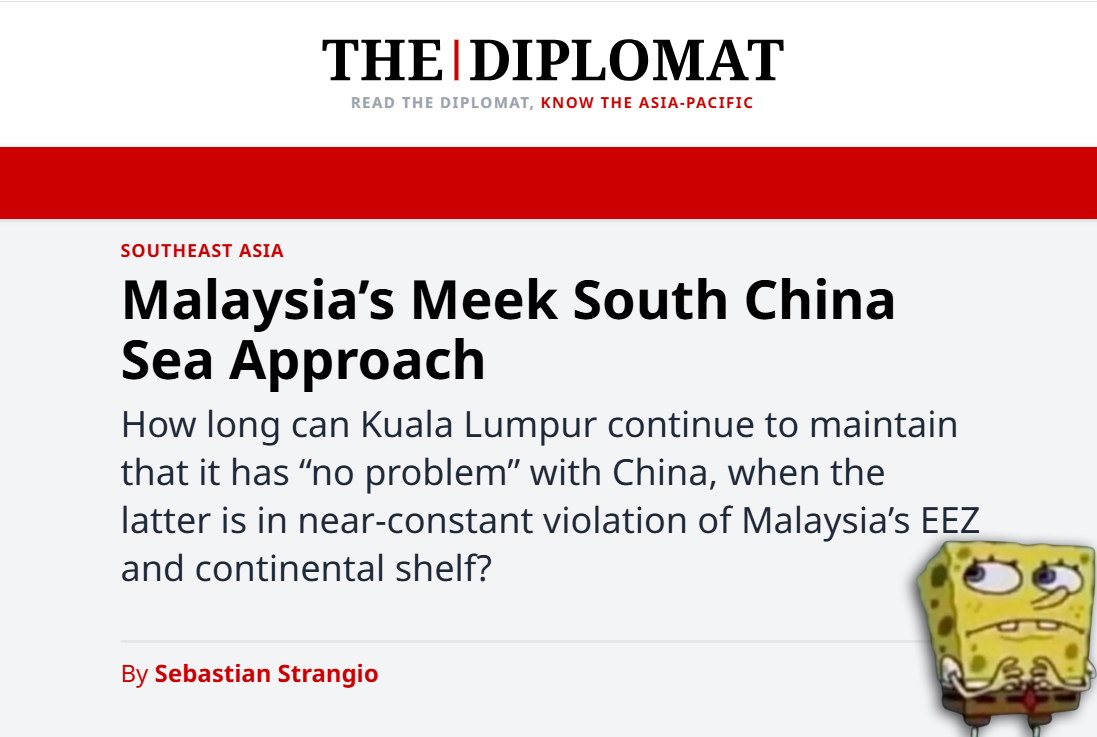
And it’s not just us saying that. Commentaries have criticised Malaysia’s wishy washy approach to the dispute, while some research has shown that Malaysian media coverage of China leans surprisingly positive. Put all of this together and it kinda leads to this slightly uncomfortable idea that Malaysian media is actually sounding like they’re on China’s side.
So are they?
To test this idea, we analysed 336 articles from English and Malay news outlets
Obviously, we couldn’t just throw a theory like this out there without doing some actual legwork, could we?
So first things first, we collabed with Danny Chew from Reform MY Media to look into how Malaysian media in different languages report on South China Sea disputes. The obvious question was whether our outlets show clear pro-China leanings. Our second working theory was that these different languages wouldn’t all tell the story in the same way, especially with how critical the coverage gets.
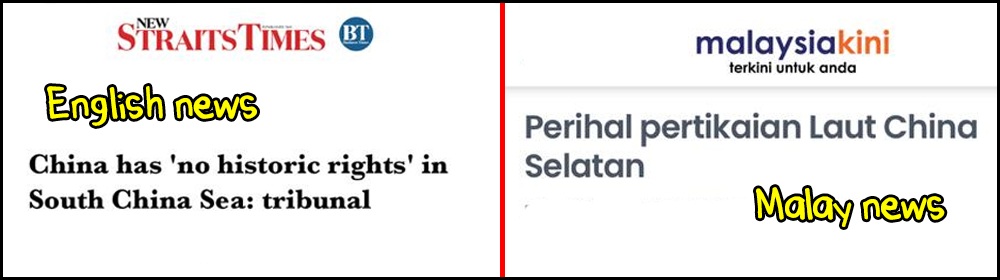
Danny and his team reviewed 830 articles from six mainstream news outlets spanning the 2024–2025 period. These came from Malaysia’s three major language media streams; Sin Chew Daily, Nanyang Siang Pau, The Star, New Straits Times, Berita Harian and Harian Metro.
And while their study covered a longer timeframe, ours focused on three incidents to examine how Malaysian media reacts across different South China Sea cases. They were;
- The 2016 arbitration ruling, where the Philippines brought China to international court over South China Sea claims
- The 2020 West Capella standoff, where a Malaysian drillship was shadowed by Chinese vessels
- The 2023 standard map controversy, where China released a new map asserting sweeping claims over the region
We did our analyses separately and on our end, things sure as heck got very manual, very repetitive and very soul draining.
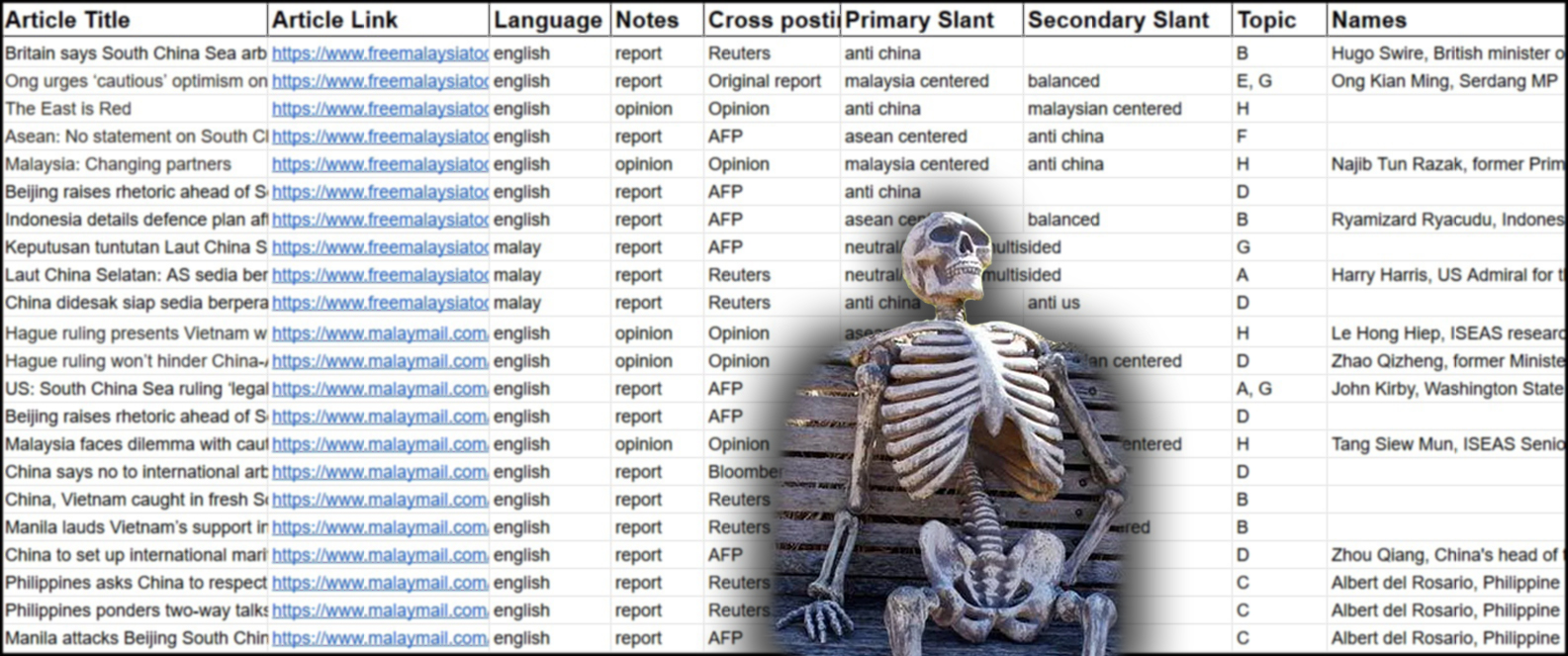
We compiled South China Sea-related keywords, then trawled through 27 English and Malay news outlets. Of those 336 articles we found, each one was then categorised based on framing i.e. whether China was portrayed in a negative, neutral or more positive/defensive light, and more broadly whether the tone leaned pro-China, anti-China, pro-US, anti-US, ASEAN-centred, Malaysia-centred, or neutral/multi-sided.
Now, a few important caveats before we move on:
- We didn’t include Chinese language media in our sample, mainly cos none of the Cilisos writers know Mandarin beyond ni hao and xie xie. Tamil language media was also excluded for the same reason
- No AI sentiment tools or machine learning models were harmed in this study 🤗. Everything was manually handled by coffee powered humans
- Some paywalled articles had to be excluded due to access limitations
- And while we tried to keep our keyword list as broad as possible, there’s still a chance some relevant articles slipped through
With that out of the way, let’s first take a quick looksie at what Danny and his team found before we get into our own findings.
Turns out, Malaysian media don’t all tell the same South China Sea story
You can actually read their full report although fair warning, it’s in Mandarin.
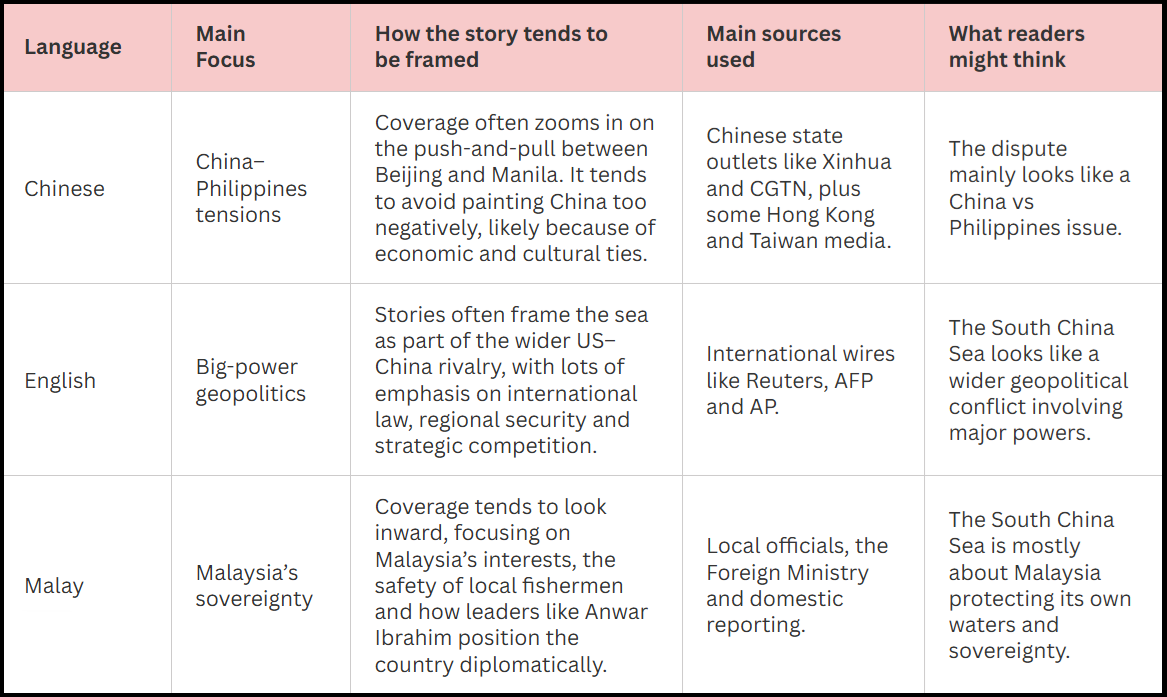
In short, their findings pretty much back up our starting suspicion. Different language media really do frame the South China Sea in different ways. Chinese media tends to focus on China–Philippines tensions, English media expands it into a broader US–China rivalry, while Malay media typically centers around Malaysia’s sovereignty and local concerns.
Here’s a breakdown of the parts that matter for our story.
A couple of other patterns popped up across the board too;
- Coverage across all languages tends to stay fairly shallow. Some analysts describe this as pragmatic apathy where the media mirrors Malaysia’s very cautious diplomatic approach
- Many local newsrooms simply don’t have the manpower for deep international reporting so they lean heavily on wire stories. For context, wire stories are reports from international news agencies like Reuters, AFP, AP and Bloomberg that local outlets can republish or adapt. This is how American-ish takes end up in English media and China-ish takes in Chinese media
Now when we compared our data with Danny’s study, some stuff lined up neatly while others came with a bit of a plot twist. To start…
English outlets are more anti-China but a lot of that tone is just borrowed
For clarity’s sake, we labelled an article as anti-China when it portrayed China as acting aggressively, breaking international rules or otherwise behaving unfairly in the South China Sea dispute.
Danny’s report suggested that English media tends to frame the South China Sea as a broader geopolitical issue, often drawing on international law, global power rivalries and commentary from outside Malaysia. And to add to that, a common assumption is that English media tends to be more critical of China compared to other languages.
Our data kinda supports that but only if you look at the big picture. Like way far back, zoomed out, preferably with a telescope.
Across all 336 articles, 24.1% of English coverage was anti-China compared to 15% in Malay media. And a big reason for that is sourcing.
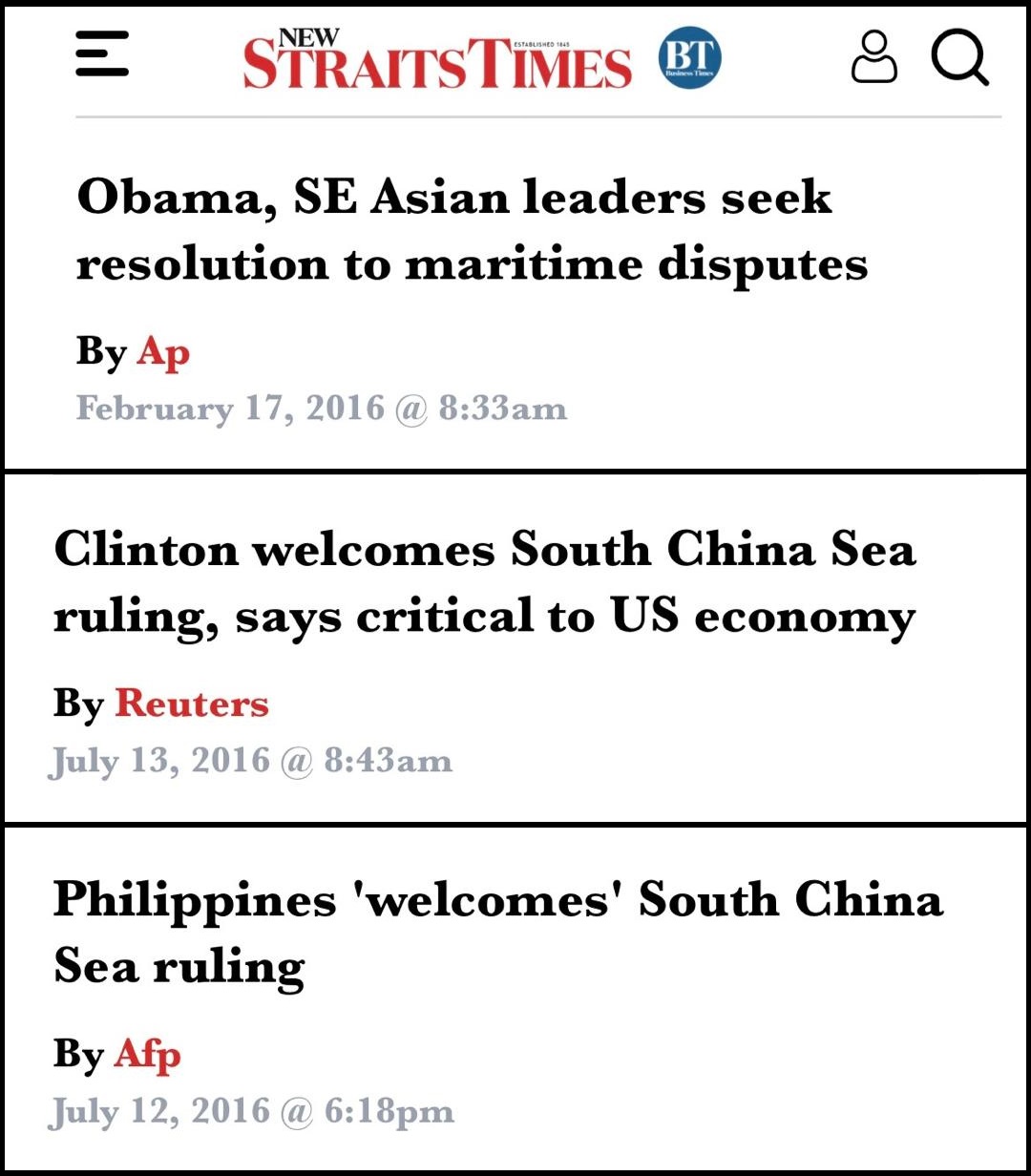
English outlets rely much more heavily on international news wires like Reuters, AFP, AP and Bloomberg which made up 41.9% of English reporting, compared to 24.1% in Malay media. And these wires already tend to be more critical– in fact, almost twice as likely to be so. Around 38–41% of wire reports criticise China, compared to about 24% of locally produced stories.
Now split these articles into straight news reporting and opinion pieces, and you get another layer of difference. Across both languages, straight news reporting plays it pretty safe. Only about 16.8% of news reports are anti-China. The sharper tone shows up in opinion writing, where that figure jumps to 41.2%.
This matters because opinion content is still a significant part of coverage.
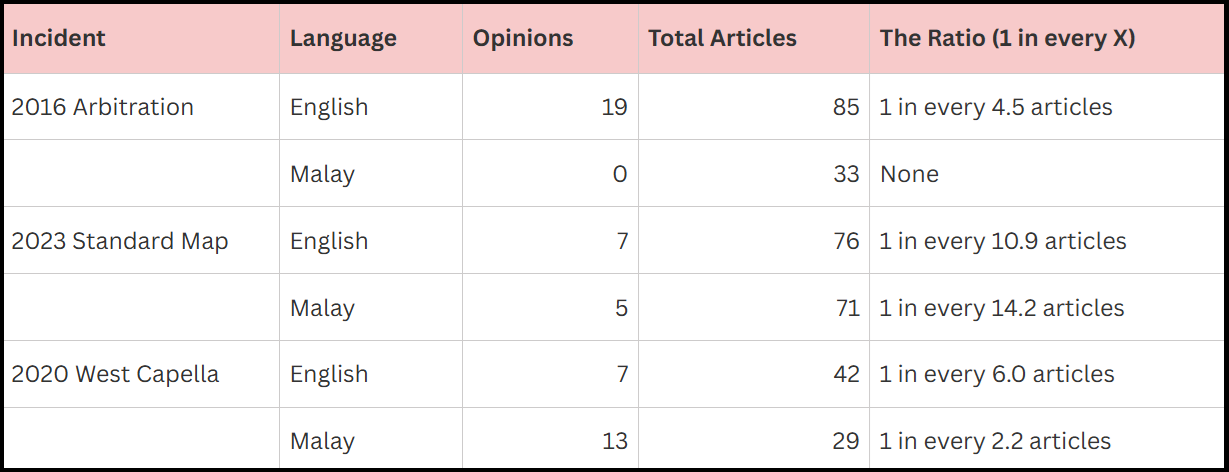
In the 2016 arbitration case, all opinion pieces we found were in English. On average, English readers also encounter opinion pieces slightly more often (about 1 in every 6 articles) compared to Malay readers (about 1 in every 7–8).
So when English coverage sounds harsher, it’s not necessarily because the journalist woke up that morning and chose violence. More often than not, the tone is imported through international wires and then reinforced again in commentary sections.
But as neat and tidy as that explanation sounds, it really only holds when you look at the data as one big ol pie. Once you slice it up by incident, the pattern becomes less consistent and more dependent on context and how close (or far) the dispute is to Malaysia.
Both languages take a diplomatic turn when the problem is in our backyard

One of the more curious patterns we found is that both English and Malay media tend to become more diplomatic the closer a dispute is to Malaysia.
At first glance, this feels a bit counterintuitive. You’d expect closer threats to trigger stronger reactions, kan? But actually, coverage became more measured and Malaysia-centered instead of confrontational. And we can break this down by looking at our three South China Sea incidents across a proximity spectrum.
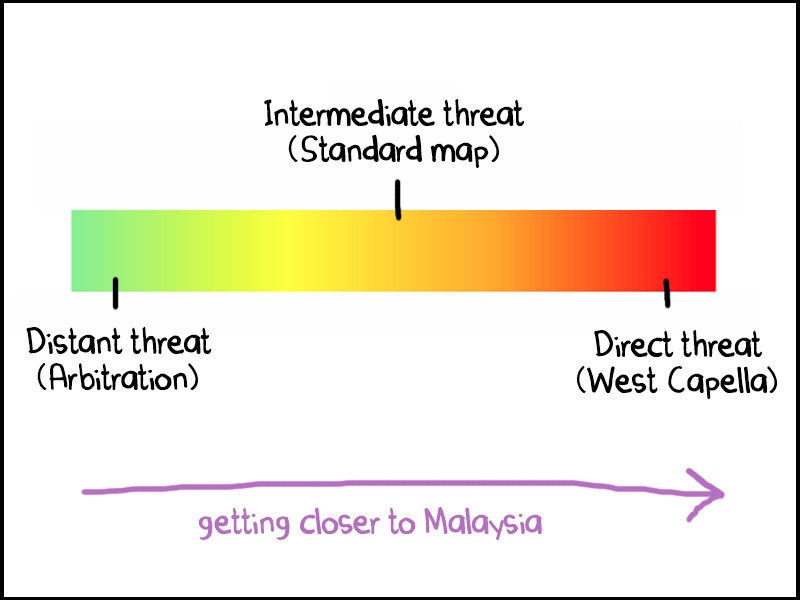
Starting with the incident that was furthest from Malaysia, the 2016 arbitration ruling was essentially a legal dispute between the Philippines and China. More importantly, Malaysia wasn’t directly involved. Here, both language groups took pretty clear cut positions with 37.6% of English articles and 33.3% of Malay articles having an anti-China stance.
Distance, in this case, mayhaps allowed for more direct framing and commentary.
The 2023 standard map incident sits somewhere in the middle of our proximity spectrum. The map itself sprawled across much of the South China Sea, asserting China’s claims over areas also claimed by Malaysia and other ASEAN countries. We wouldn’t go so far as to call it a confrontation but Malaysia was still indirectly drawn into a wider diplomatic dispute.
With this one, English coverage shows a higher level of anti-China framing (18.4%) compared to Malay coverage (8.5%). But more importantly, the focus of reporting was predominantly Malaysian centered, with 57.9% of English stories and 52.1% of Malay stories focused on Malaysia’s sovereignty and response.
To round it all out, we have the 2020 West Capella incident. This was our closest point of contact with Chinese ships literally parking themselves inside Malaysian waters. But instead of things getting heated, the anti-China sentiment actually faded right down (😱) to just 7% in English and 10% in Malay!
Like the Standard Map incident, both language groups (42.9% of English and 44.8% of Malay) pivoted to a Malaysian-centric narrative.
So at this point, we have English media leaning more anti-China overall but turning more diplomatic when the issue is close to home. And Malay media also turns diplomatic when the issue is close to home… so outside of that, does it lean pro-China or something? Eh, not quite.
Malay media, frankly, would rather just talk about Malaysia
As Danny’s research suggests, Malay language coverage of the South China Sea tends to be more inward-looking, framing events primarily through a Malaysian lens. And to that effect, the emphasis falls more on our sovereignty, political leadership and domestic implications of South China Sea happenings.
Across our dataset, 39.8% of Malay coverage focused on Malaysia compared to 32.5% of English reporting. Okay, sure, it’s not the biggest gap but it shows up again and again in smaller patterns throughout the reporting.
For instance, even when Malaysia wasn’t directly involved, Malay outlets were still more likely to pull the story back home. During the 2016 South China Sea arbitration case, only 4.7% of English reports focused on how the ruling might affect Malaysia. In Malay coverage, that number was almost double at 9.1%.
You can also see this tendency in the sources being used.
In the 2023 Standard Map controversy, nearly 39.4% of Malay coverage came from Bernama, Malaysia’s national news agency, which naturally frames events through Malaysia’s official diplomatic position. English outlets used Bernama too but relied a lil more on international wires that widened the story beyond Malaysia.
Another way to see this pattern is in who gets mentioned in the reporting.
During the 2016 arbitration case, English reports referenced 35 different political figures, including foreign leaders like Philippine president Rodrigo Duterte and our ex-PM Najib Razak. Malay coverage by comparison, featured just 13 unique political figures, with the narrative much more tightly centered on Malaysia’s own leadership.
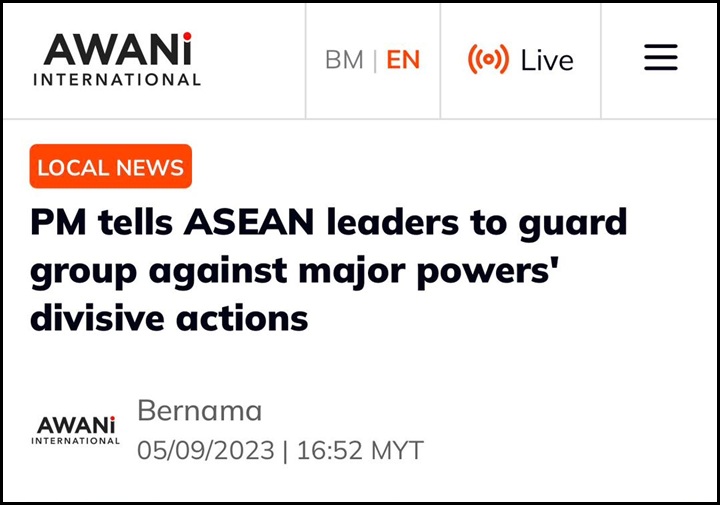
Then in the 2023 Standard map incident, both English and Malay reports prominently featured PM Anwar Ibrahim although in Malay coverage, he appeared far more often on his own rather than alongside other political figures. And that effectively made him the clear central character of the story.
So now after all that data…
Where exactly does Malaysian media stand?
After sleepless nights of trawling through 336 articles and comparing notes with Danny’s team, the final picture that we’re getting out of this actually………. pretty consistent. Malaysian media, across both languages, tends to default to a pro-Malaysia frame.
We’ve covered a lot of ground (and probably a few too many charts), so here’s the gist of our findings for you;
- English media sounds more anti-China overall
- But much of that sharper tone actually comes from international wire stories like Reuters and AFP
- When disputes happen closer to Malaysia, both English and Malay media become more diplomatic and Malaysia-focused
- Malay coverage tends to center Malaysia more strongly, especially local leaders and sovereignty issues
What this really tells us is that it’s hard AF to be 100% impartial. Every story gets filtered through language, sourcing and editorial choices along the way. Whether it’s English media borrowing tone from international wires or Malay media leaning on more local framing, both are ultimately trying to report a messy geopolitical issue without overstepping too hard.
So if we circle back to our starting question, Malaysian media is far from supportive of China. In fact, coverage can be pretty critical at times though the backbone of straight reporting still tends to be careful and restrained.
And while that might come off as a bit meek compared to more openly confrontational reporting in say the Philippines or Vietnam, it’s also a reflection of how Malaysian media tends to operate alongside our country’s generally cautious diplomatic style. Which honestly, in this region, is basically a superpower on its own so you can bet we’re counting that as a win.